

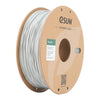
eSUN TPU-LW 3D Printing Filament, Foaming TPU, Lightweight, Density Adjustable up to 172%
3 min reading time
3 min reading time
eSUN TPU-LW is a special type of TPU filament that self-foams during printing. Its density and hardness can be freely adjusted through temperature and print head speed. It has a soft, velvet-like texture, making it suitable for cosplay, wearable items, and ultra-lightweight aircraft/boat models.
Among flexible 3D printing filaments, common TPUs like TPU-95A or TPU-85A offer high flexibility and durability. However, what standard TPUs cannot do is "reduce weight" and "adjust the density" of printed parts according to user preferences. eSUN has therefore developed TPU-LW, a special TPU filament with in-process foaming properties during printing, resulting in lightweight, soft parts that retain all the flexibility of TPU.
TPU-LW is a TPU material designed to create small air bubbles within its structure while being melted and extruded from the nozzle. This process is called foaming, which differs from standard TPU that has a solid, dense material throughout the part. The key advantage is that users can control the degree of foaming by adjusting the nozzle temperature and printing speed. The higher the temperature at the same speed, the greater the foaming rate, resulting in a lighter and softer part. Conversely, if the printing speed is increased at the same temperature, the foaming rate will decrease, making the part denser and stronger. With this mechanism, the same user can adjust a single material formula to achieve different properties for each project, without having to change filaments.
The maximum foaming rate of TPU-LW is 172% compared to the normal material volume, which is very high for flexible materials in this category. The surface of the finished printed part has a fine matte finish, similar to velvet or fine sand, and hides layer lines better than general materials because the small air bubbles help to cover the joints between layers. In addition, the material retains high flexibility, tear resistance, and good resilience; it returns to its original shape when pressed or squeezed. Most importantly, the printed parts are soft and skin-friendly, making them suitable for applications that require direct contact with the body.
With its lightweight, flexible, and soft properties, TPU-LW is suitable for various applications such as parts for remote-controlled aircraft models and model boats that require strict weight control, cosplay accessories and props that need to be worn for long periods and require softness and comfort, flexible wearables like straps or shock-absorbing sleeves, and sports equipment that requires impact absorption while remaining lightweight.
The recommended nozzle temperature for TPU-LW is in the range of 210-270 degrees Celsius, while the bed temperature is 40-60 degrees Celsius. The cooling fan should be set to 100%, and the printing speed should not exceed 100 mm/s. The material density is approximately 1.15 grams per cubic centimeter, and the Melt Flow Index is 5 grams per 10 minutes at 190 degrees Celsius and a 10 kg load. The most important thing is to disable the retraction function in the slicer, as the material continues to foam in the hot end's melt zone. Retraction will be ineffective and may cause voids within the nozzle, leading to clogging. If stringing occurs during non-printing movements, this is normal for this type of material and can be mitigated by using Vase Mode to reduce the impact on the part's surface.
Most printers using PTFE tubing should not print at temperatures exceeding 250 degrees Celsius for extended periods, as this may damage the tubing and cause clogs. For higher temperature printing, a printer with an all-metal hotend should be used. Additionally, the first layer print speed should be set to 100% of the actual print speed, and the automatic slowdown function for small areas should be disabled, as sudden changes in temperature or speed will affect the foaming rate and lead to uneven layer lines on the part's surface. Before printing, the filament should always be dried at 55 degrees Celsius for at least 4 hours, as TPU-LW is hygroscopic and moisture will directly affect the material's foaming quality.
eSUN TPU-LW opens up new possibilities for flexible material printing with its ability to foam and adjust density by up to 172%. This allows users to freely control both the weight and softness of parts by simply adjusting the printing temperature and speed. It is ideal for model aircraft/boat enthusiasts, cosplayers, and those who want to print soft and comfortable wearable products. Although it requires slightly more detailed settings than standard TPU, the result is a versatile material that offers both lightness and flexibility in a single filament.


